Refrigerator Repair
Best Sub-Zero Temperature to Keep Food Fresh
- Written by
- Tobias Reinhardt
- Role
- Refrigeration technician — doors, gaskets and cabinet fit
- In the trade
- 9 years in the trade
- Certified
- EPA Section 608 certified
The coldest setting is not the freshest one. For food that keeps longest, hold the fresh-food compartment between 36°F and 38°F and the freezer at 0°F. Sub-Zero ships its Classic (CL) and Designer (DET, DEC) controls at 38°F and 0°F (3°C and -18°C), squarely inside that window, and the FDA’s ceiling for the refrigerator is 40°F (4°C). Going below 36°F gains nothing: the Department of Energy’s efficiency program points out that it only raises power use, while tender greens at the back of a shelf begin to freeze. The real work is confirming that the cabinet holds the number on its screen, which in a dry, sunny Denver kitchen is not something to assume.
The right number for each compartment
| Compartment | Aim for | Notes |
|---|---|---|
| Fresh food | 36°F to 38°F | Slows spoilage without freezing produce |
| Refrigerator drawers | 2° under the main setting | Auto Mode on CL, DET and DEC never drops below 34°F |
| Freezer | 0°F | The DOE accepts -5°F to 0°F |
| Wine storage (DEU) | 40°F to 65°F | Chosen for the wine, not for food safety |
Treat 40°F as the warning line and 45°F as the hard stop: Sub-Zero states plainly that food held above 45°F is not safe. The gap between those two marks is where milk sours ahead of its date and cooked leftovers lose their margin.
Why a Sub-Zero keeps food differently
Many conventional refrigerators chill both sides from a single coil, so the freezer keeps pulling moisture out of the fresh-food air. Sub-Zero’s Dual Refrigeration gives the refrigerator and the freezer their own separate systems. Fresh-food air keeps its humidity instead of being frozen dry, and frozen food and ice stay clear of onion and cheese odors. That is a large part of what separates a Sub-Zero from a typical fridge at the same setting. It also means each side drifts on its own, so check both compartments rather than assuming one tells you about the other.
How far each Sub-Zero control can be set
Classic (CL) and Designer (DET, DEC) refrigerators move from 34° to 42°F in one-degree steps. Classic (BI) and Designer (IT, IC, ID) models reach 45°F at the warm end, and their freezers span -5° to 5°F. On CL, DET and DEC units, Manual Mode lets the drawers sit 2° above or below the main cabinet, still within 34°F to 42°F, handy for a drawer of drinks or delicate greens.
Older units with a dial, the 500 Series among them, show no temperature at all. Sub-Zero suggests a dial position between 4 and 6, and the scale runs opposite to what many owners guess: 1 is the warmest.
Whatever the control, allow 24 hours after any change before you judge the result.
Checking the cabinet with a thermometer
The display tells you what the control is aiming for. The FDA says an appliance thermometer is the best way to learn what the food is actually experiencing.
- Stand the thermometer in a glass of water on a middle shelf near the front; the water damps out the warm puff from each door opening.
- Leave it overnight and read it before breakfast traffic starts.
- Slip a second thermometer between frozen packages in the freezer and read it at the same moment.
- Take one more pair of readings that evening and again the next day.
Readings within a degree or two of the setpoint are healthy. Three or more degrees off, trust the thermometer and adjust one step at a time.
Why a sound setting still drifts
Usually it is the way the cabinet gets used, not a broken part.
- Door bins. They run warmer and swing more than the shelves, so keep milk, cream and raw meat inside and leave eggs in their carton on a shelf.
- Crowded shelves. Packages pushed against the vents leave warm pockets; our page on loading for airflow shows the spacing.
- Door habits. Each opening lets kitchen air roll in, so decide what you need first.
- Stiff gaskets. Denver’s dry air ages door seals, and a seal that no longer grips leaks warmth all day. See keeping the seal soft.
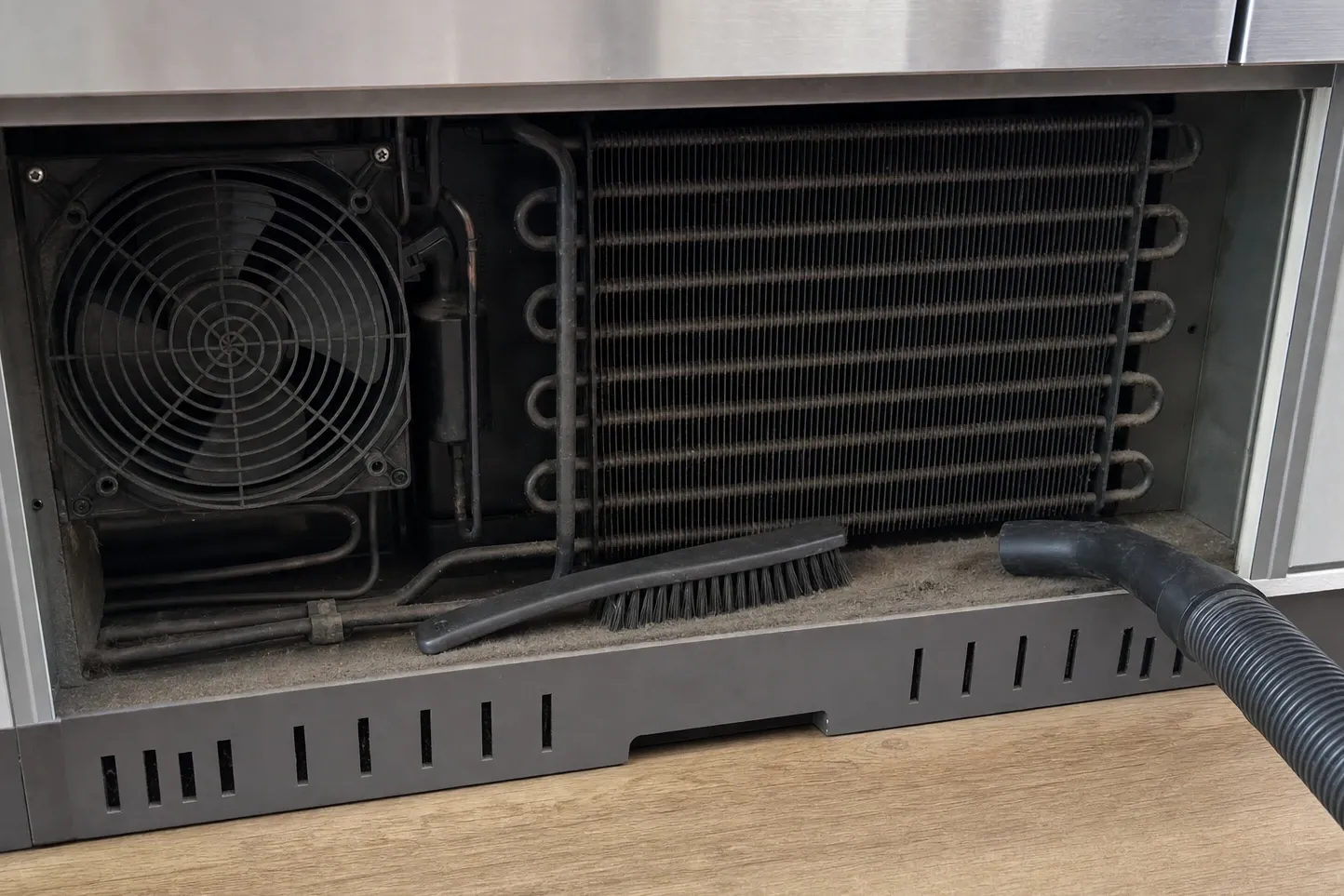
- Summer heat. Afternoon sun on a west wall, or a dusty condenser, stretches every run cycle.
Two settings that look like a broken fridge
Rule these out before assuming the worst. On a Classic (BI), Sh r on the display means Showroom Mode, and the unit will not cool. To get out of it, turn Power off first; then, with a Warmer and Colder pair held down, press Power once more and lift your fingers from all three together.
A PRO 36 or PRO 48 that was ever set to Showroom mode slips back into it after a power failure; it is turned off through the password-protected Service screen in the Settings menu.
A warm-coil code and a chiming alarm
On a Classic (BI), error 10 r 09 means the evaporator thermistor read at least 10 degrees above the cabinet thermistor. Switch the breaker off for 30 seconds, then back on; if no new error follows, nothing more is needed. Silencing a chiming BI alarm, by holding the Alarm and Power keys together and letting go in under 5 seconds, hides the warning for 24 hours but fixes nothing.
When it will not come back down
If the water glass still reads above 40°F a full day after you lowered the setting, something mechanical is wrong: a seal, a fan, a defrost part or, less often, the sealed system. When the unit also runs without a break, our guide to a Sub-Zero running constantly and still drifting warm covers the likely causes. Meanwhile, move dairy, meat and leftovers to a cooler packed with ice.
We work in University Hills, Cheesman Park, Platt Park and Park Hill; phone (720) 790-9436, or book through the button on this page. The $89 visit gets the cabinet read with proper instruments, and that charge disappears from the invoice when you go ahead with the repair.
Follow-ups
Why does my thermometer read warmer than the Sub-Zero display?
A gap of a degree or two is normal, because the control sensor and your thermometer sit in different spots. Give any new setting 24 hours, then read the water glass again. If it still shows above 40°F, drop the setpoint one degree and wait another day; if two such steps change nothing, the cabinet is not responding and needs a diagnosis.
Should milk and eggs go in the door of a Sub-Zero?
No, keep them inside the cabinet. USDA food-safety guidance notes that door bins swing in temperature more than the shelves do, so milk, cream and other perishables last longer on an interior shelf, and eggs belong in their original carton rather than the door tray.
How long does a Sub-Zero stay cold during a power outage?
With nothing inside to hold the chill, the maker expects the freezer to warm beyond 20°F (-6°C) and the fresh-food section beyond 45°F (7°C) inside about 3 hours, so a full cabinet with both doors kept shut is your best defense until power returns. Afterwards, look at the display: a PRO 36 or PRO 48 that was ever placed in Showroom mode comes back in that mode, and switching it off goes through a password-protected Service screen.
What does it cost when a Sub-Zero will not hold its temperature?
It depends on the failed part. Typical spans are $300–$680 for a hardened door gasket, $330–$720 for an evaporator or condenser fan motor and $280–$680 for a defrost heater, thermostat or sensor. You get a firm quote after diagnosis, and the $89 visit charge comes off the bill once you approve the repair.